Downcasting Arcs in Rust
The Arc type is Rust’s thread-safe smart pointer, and like other pointer types in Rust (e.g., Box), one can use the as keyword1 to cast an Arc<MyStruct> into an Arc<dyn MyTrait>, as long as MyTrait is dyn compatible.
What about casting it back from Arc<dyn MyTrait> to Arc<MyStruct>? Well, here the plot thickens a bit. We can’t use the as keyword here, because that operation is inherently unsafe. An arbitrary Arc<dyn MyTrait> might not hold a MyStruct in it, but some other object that implements MyTrait, and trying to cast it into the wrong type would result in undefined behaviour. But the fact that something is unsafe doesn’t mean it should be impossible, or even undesirable.
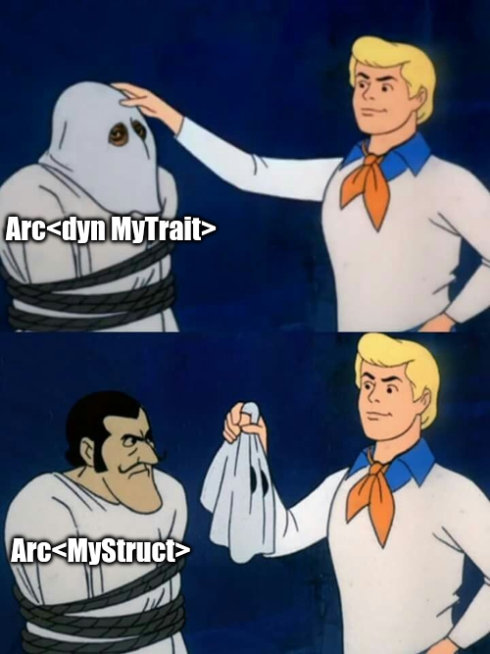
Why would I want to do that?
Arc has a few nice functions such as into_inner that allow you to consume it if you’re the only owner and unwrap the contained value. This is not possible for unsized types (such as dyn MyTrait) since they can only reside on the heap. So if we have an Arc<dyn MyTrait> that we’re 100% sure was originally created as an Arc<MyStruct>, and we want to extract that MyStruct out, we can’t do that unless we first convert the Arc back to an Arc<MyStruct>.2
So I’d like to implement the following function:
/// Calling this is only safe if `arc` was originally created
/// as an `Arc<MyStruct>`.
unsafe fn downcast(arc: Arc<dyn MyTrait>) -> Arc<MyStruct>
Is there no simple solution?
Currently, Arc has support for downcasting from dyn Any through the fallible downcast. There’s also an unconditional downcasting in nightly, in the form of downcast_unchecked.
But what if my trait isn’t a subtrait of Any? We obviously can’t implement the casting safely, but there should still be an unsafe way to achieve what we want. We just need to use the available API a bit more creatively.
Raw pointer conversions
The Arc type provides the functions into_raw and from_raw to convert Arcs to and from raw pointers (*const T).
What would happen if we convert an Arc<dyn MyTrait> into a pointer, and then convert that pointer to an Arc<MyStruct>? Is this safe? Let’s check the docs.
The docs for Arc<T>::from_raw have a lengthy list of safety requirements, the important ones for our case are:
- The raw pointer must have been previously returned by a call to
Arc<U>::into_raw
Note that we have two types here, U and T, the two types aren’t required to be identical, so we’re good on this front.
- If
Uis unsized, its data pointer must have the same size and alignment asT. This is trivially true ifArc<U>was constructed throughArc<T>and then converted toArc<U>through an unsized coercion.
The last sentence describes our situation exactly, so we’re good here as well!
All we need to do is implement our function:
/// Calling this is only safe if `arc` was originally created
/// as an `Arc<MyStruct>`.
unsafe fn downcast(arc: Arc<dyn MyTrait>) -> Arc<MyStruct> {
    let ptr = Arc::into_raw(arc);
    unsafe { Arc::from_raw(ptr.cast()) }
}
Wait, why aren’t we done?
Before we go on our merry way, let’s check what the function actually compiles into, specifically in comparison to the upcast. We use Compiler Explorer with the following code:
use std::sync::Arc;

pub struct MyStruct;
pub trait MyTrait {}

impl MyTrait for MyStruct {}

#[unsafe(no_mangle)]
pub fn upcast(arc: Arc<MyStruct>) -> Arc<dyn MyTrait> {
    arc as _
}

#[unsafe(no_mangle)]
pub unsafe fn downcast(arc: Arc<dyn MyTrait>) -> Arc<MyStruct> {
    let ptr = Arc::into_raw(arc);
    unsafe { Arc::from_raw(ptr.cast()) }
}
to get this assembly output (with my own comments)
upcast:
        ; Copy the input pointer into the first output register
        mov     rax, rdi
        ; Load a pointer to MyStruct's virtual table into the second
        ; output register
        lea     rdx, [rip + .Lanon.09a60105b64a7b096223e4c3559521b0.0]
        ret

; MyStruct's virtual table
.Lanon.09a60105b64a7b096223e4c3559521b0.0:
        .asciz  "\000\000\000\000\000\000\000\000\000\000\000\000\000\000\000\000\001\000\000\000\000\000\000"

downcast:
        ; Uhhhh...
        mov     rax, qword ptr [rsi + 16]
        ; wat?
        dec     rax
        ; why?
        and     rax, -16
        ; huh?
        add     rax, rdi
        ret
The upcast is very simple, it just converts a regular pointer into a fat pointer - a pointer + metadata, which in the case of a dyn object is another pointer, to the original type’s virtual table.
But the downcast managed somehow to become significantly more complicated with all kinds of unexpected arithmetic instructions, instead of just copying the pointer part of the input into the output with a single mov rax, rdi instruction.
We can’t leave it like that, right?
What is going on?
In order to understand what’s going on, we first need to look at the (highly edited) innards of Arc<T>:
struct Arc<T> {
    ptr: NonNull<ArcInner<T>>,
    // Stuff ...
}

#[repr(C)]
struct ArcInner<T: ?Sized> {
    strong: Atomic<usize>,
    weak: Atomic<usize>,
    data: T,
}
So Arc<T> is simply a pointer to an ArcInner<T>, which is two atomic usizes (8 bytes each) followed by our T4. But here is the catch! There might be a gap between weak and data, depending on the alignment of T.
Our T’s alignment requires its address to be a whole multiple of some power of 2, which, in turn, forces ArcInner’s address to also be a whole multiple of the same power.
The atomic counters in ArcInner already force it to have a minimum alignment of 8, so if T was itself a usize with an alignment of 8 as well, the end of weak would be divisible by 8 and would be a valid address for data.
+-------+-------+-------+
|strong | weak  |data   |
+-------+-------+-------+
0       8      16      24
If, however, T had an alignment of 32, we’d need a padding of 16 bytes between weak and data, to make sure its address divides by 32:
+-------+-------+---------------+
|strong | weak  |   <padding>   |
+-------+-------+---------------+
0       8      16              32
+-------------------------------+
|             data              |
+-------------------------------+
32                             64
Now, remember that Arc<T> is simply a pointer to ArcInner<T>, so it points to the beginning of the above diagrams. That means that the offset between the Arc’s pointer and the pointer to the data (which is what we get when we call Arc::into_raw) depends on T, or more specifically, on the alignment of T.
Understanding the downcast, take 2
Armed with a new perspective, we can decipher the assembly code for our downcast function:
downcast:
        ; Load the alignment of the input type from the
        ; input virtual table
        mov     rax, qword ptr [rsi + 16]

        ; Round down to the previous multiple of 16,
        ; giving the padding in `ArcInner`
        dec     rax
        and     rax, -16

        ; Add the result to the input pointer!?
        add     rax, rdi
        ret
If the alignment is smaller or equal to 16, rounding down will net you a padding of 0, and any other alignment a will net you a padding of a-16 as expected.
But why are we adding the padding to the Arc’s pointer - the address of ArcInner? That makes no sense at all!
Understanding the downcast, take 3
The culprit this time is the compiler’s optimisations, and we can fight them by splitting our function into two parts, the into_raw and the from_raw:
#[unsafe(no_mangle)]
pub fn downcast_into_raw_part(arc: Arc<dyn MyTrait>) -> *const MyStruct {
    Arc::into_raw(arc).cast()
}

#[unsafe(no_mangle)]
pub unsafe fn downcast_from_raw_part(ptr: *const MyStruct) -> Arc<MyStruct> {
    unsafe { Arc::from_raw(ptr) }
}
Suddenly new assembly lines appear:
downcast_into_raw_part:
        ; Load the alignment of the input type from the
        ; input virtual table to the output register
        mov     rax, qword ptr [rsi + 16]

        ; Round down to the previous multiple of 16,
        ; giving the padding in `ArcInner`
        dec     rax
        and     rax, -16

        ; Add the input pointer to the result
        add     rax, rdi

        ; Add 16 to the result
        add     rax, 16
        ret

downcast_from_raw_part:
        ; Load the input pointer minus 16 to the output register
        lea     rax, [rdi - 16]
        ret
Both parts make sense now:
into_rawadds the padding + 16 (the total size of thestrongandweakcounters) to the base address of theArcInner, to give us the address ofdata.from_rawsubtracts 16 from the address of thedatato get us the address of theArcInner. It doesn’t need to subtract any padding, since it knows it’s anArc<MyStruct>, andMyStructhas an alignment of 1 and therefore needs no padding.
When the two parts come together, the last instruction of the into_raw part (add 16) and the first instruction of the from_raw part (subtract 16) cancel each other, and the compiler throws them out, which is how we ended up with the weird code above.
The fact that from_raw doesn’t need to subtract any padding means that into_raw doesn’t need to do that either. You know that, I know that, but it appears nobody told this to the compiler.
Nothing in the API informs the compiler that our arc: Arc<dyn MyTrait> input variable is guaranteed to contain a MyStruct, which has an alignment of 1.
Speaking compilerish
Rust has a very powerful interface to convey information to the compiler in the form of the assert_unchecked hint.
If we assert that the alignment of the data in the Arc<dyn MyTrait> is equal to the alignment of MyStruct, the compiler should have enough information to remove the unnecessary arithmetic:
#[unsafe(no_mangle)]
pub unsafe fn downcast_with_hint(arc: Arc<dyn MyTrait>) -> Arc<MyStruct> {
    unsafe {
        std::hint::assert_unchecked(
            std::mem::align_of_val(arc.as_ref()) ==
            std::mem::align_of::<MyStruct>(),
        )
    };
    let ptr = Arc::into_raw(arc);
    unsafe { Arc::from_raw(ptr.cast()) }
}
Does it work? Yes, it does!
downcast_with_hint:
        ; Copy the input pointer into the output register
        mov     rax, rdi
        ret
The arithmetic is gone, and our function is finally as simple as it should be.
Will I use this?
Probably not. But that’s not the point!
I mostly went down this rabbit hole because I was annoyed that an operation which should have been trivial wasn’t. In the process, I learned a bit about the internals of Arc and alignments6, and maybe you did too :)
-
An unsized coercion if you want the fancy term. ↩
-
That’s not an entirely hypothetical situation. The
arrowcrate’s API usesArc<dyn Array>everywhere, whose reference can be safely downcast to specific types (e.g.,&Int32Array) by using theArray::as_anyfunction. But if we want anInt32Arrayon the stack (to use one of its consuming functions, such asinto_parts), our only option is to clone that reference. Admittedly not a very expensive operation, but definitely avoidable if we hold the only reference. See this issue for instance. ↩ -
The entire post is relevant for
Rcas well, I just happened to investigate this stuff usingArcsince I use it much more often. ↩ -
The
#[repr(C)]keeps the order of the fields in memory identical to their order in the declaration. ↩ -
The alignment is read from
rsi + 16, which is the 16th byte of the virtual table. If you look at the binary data of the virtual table in the assembly output, you’ll find that the 16th byte has a value of1, which is exactlyMyStruct’s alignment as a zero-sized struct.; MyStruct's virtual table .Lanon.09a60105b64a7b096223e4c3559521b0.0: .asciz "\000\000\000\000\000\000\000\000\000\000\000\000\000\000\000\000\001\000\000\000\000\000\000" -
As well as LLVM IR and MIR, which I decided to spare from the reader. ↩